 blog
How to Choose Leasing vs Buying Security Screening Equipment
Last Updated: November 5, 2026
Quick Summary
Leasing vs buying security screening equipment depends on how long you keep it and how you finance it. Leasing spreads cost into predictable payments and keeps you on a replacement cycle, while buying concentrates cost upfront and gives you full asset control. Buying usually wins for permanent, long-horizon checkpoints; leasing wins for tight budgets and shorter replacement cycles.
- Leasing turns a large capital expenditure into a fixed operating expense for tight annual budgets.
- End-of-term clauses, including return conditions and buyout formulas, decide whether a lease works.
- Operating leases suit short replacement cycles; finance leases fit permanent checkpoints you intend to keep.
- Rental fits needs measured in days or weeks, while leasing fits continuous screening of a year or more.
- Build a five-line TCO model covering acquisition, operation, maintenance, compliance, and replacement.
Table of Contents
- Leasing vs Buying Security Screening Equipment: The Core Trade-Off
- Advantages and Disadvantages of Leasing Screening Equipment
- Advantages and Disadvantages of Buying Metal Detectors and Scanners
- Leasing vs Buying Security Screening Equipment Cost: Upfront, Monthly, and Lifetime
- Security Screening Equipment Lease Terms You Need to Read
- Security Equipment Rental vs Leasing: Which Fits Temporary and Event Screening?
- Total Cost of Ownership for Metal Detectors: The Full Lifecycle Model
- Matching the Acquisition Model to Your Deployment Scenario
- Frequently Asked Questions
Leasing vs Buying Security Screening Equipment: The Core Trade-Off
Leasing vs buying security screening equipment comes down to one question: protect cash flow and stay current, or own an asset outright and control it fully?
Leasing spreads cost into predictable payments and keeps you on a replacement cycle.
Below, we break down the trade-offs, including costs most vendors leave out.
Advantages and Disadvantages of Leasing Screening Equipment
Leasing wins on cash flow and flexibility. It costs you control and, over a long horizon, money. A lease is a financing tool, not free equipment.
Where Leasing Wins: Cash Flow, Upgrades, and Predictable Payments
The biggest advantage is turning a large capital expenditure into a fixed operating expense. For a school district or event venue on a tight annual budget, that difference decides whether a screening program happens this year.
Three practical wins stand out:
- Predictable payments. You know the monthly figure for the full term, which makes budget planning straightforward.
- Working capital stays free. Money you would have spent upfront stays available for staffing, training, and access control.
- Upgrade paths. Shorter terms let you refresh hardware as detection technology and threat profiles change.
If you want to see how a program is structured in practice, our team can walk you through leasing a walk through metal detector with terms matched to your budget cycle.
Where Leasing Costs You: End-of-Term Limits and Lifetime Spend
The trade-off: you pay for use of the equipment, not the equipment itself. Over a long horizon, total payments can exceed the purchase price, the cost of spreading risk and preserving cash.
Watch out: end-of-term options are where leases surprise people. Return conditions, restocking fees, and buyout formulas are set in the contract, and a lease that looked cheap can get expensive at renewal.
Advantages and Disadvantages of Buying Metal Detectors and Scanners
Buying gives you an asset you control for its full useful life, but puts every risk, repair bills, obsolescence, on your books. For permanent, high-volume checkpoints, ownership often makes sense. For temporary or fast-changing deployments, it often does not.
Where Buying Wins: Asset Control, Depreciation, and No Residual Value Risk
Ownership means no lease payments, no end-of-term negotiation, and no return conditions.
Ownership may carry tax considerations that differ by location and entity type, so confirm specifics with your accountant.
Control matters most for government facilities and permanent K-12 installations, where the screening checkpoint is part of the building and the equipment will run for years.
Where Buying Costs You: Upfront Capital and Obsolescence Risk
The purchase price lands in one budget cycle, the hard part for procurement officers facing a capital freeze or mid-year cut.
Then there is obsolescence. Detection technology improves, threat profiles shift, and a detector you bought outright can feel dated long before it stops working.
Buying also makes you responsible for maintenance, repairs, and calibration scheduling, real costs that belong in your budget from year one.
Leasing vs Buying Security Screening Equipment Cost: Upfront, Monthly, and Lifetime
There is no single answer on cost, because the cheaper option depends on how long you keep the equipment and how you finance it.
Use this comparison as a starting framework, then plug in your own quotes:
| Factor | Leasing | Buying |
|---|---|---|
| Upfront cost | Low or none | Full purchase price |
| Monthly cash flow | Fixed lease payments | Zero after purchase |
| Total cost over time | Higher if kept long-term | Lower if kept to end of useful life |
| Technology refresh | Built into shorter terms | Your cost to replace |
| Maintenance | Often bundled or optional | Your responsibility |
| End-of-term | Return, renew, or buyout | You keep the asset |
| Best for | Tight budgets, temporary needs | Permanent, long-horizon sites |
For a deeper look at how the numbers stack up across term lengths, see our breakdown of metal detector leasing options for businesses in 2026.
Security Screening Equipment Lease Terms You Need to Read
Lease terms decide whether the deal works for you, not the headline payment. Two leases can show the same monthly figure and produce very different lifetime costs once structure, end-of-term mechanics, and service coverage are factored in.
Lease structure: operating vs finance
Most screening-equipment leases fall into one of two buckets, and the distinction changes your accounting, tax treatment, and end-of-term options.
- Operating lease. Treated more like a rental. Payments are typically expensed, the lessor retains residual risk, and you usually return the equipment or renew at the end. This structure fits short replacement cycles and temporary or pilot deployments.
- Finance lease (capital lease). Treated more like a financed purchase. You generally carry the asset and the liability on your books, may claim depreciation and interest, and often get a bargain or fixed-price buyout at the end. This structure fits permanent checkpoints where you intend to keep the equipment through its useful life.
Ask the lessor which structure the contract creates and how your accountant will treat it. The same payment schedule can land in either bucket depending on the clauses.
Term length and replacement cycle
Match the term to your replacement cycle, not the salesperson's target. Walk-through metal detectors and X-ray scanners have long physical lives, but detection standards and threat profiles evolve. A term that runs past the point where you would want to upgrade locks you into aging hardware; one that ends too early leaves you renegotiating before the equipment has paid for itself.
Contact Us For Your Ordering & Rental Needs →
End-of-term options and buyout formulas
This is where leases surprise people. Confirm in writing which end-of-term paths exist and how each is priced:
- Return. What condition standard applies, and what restocking or refurbishment fees can be charged?
- Renew. Is the renewal rate fixed, or set at the lessor's discretion at the end of the term?
- Buyout. Is it fair market value (FMV) or a fixed price? FMV buyouts depend on an appraisal you may not control; fixed-price buyouts are predictable but usually carry a higher payment during the term.
Watch out: a lease with a low monthly payment and an FMV buyout can cost more over its life than a slightly higher payment with a fixed buyout, because the FMV is set at the lessor's appraisal when the equipment is already installed at your site.
Maintenance, service coverage, and uptime
For screening equipment, service coverage is not a footnote. Confirm what the lease includes: preventive maintenance visits, calibration, repair labor and parts, loaner or replacement equipment during downtime, and response-time commitments. A lease that bundles service can be cheaper than a bare lease plus a separate service contract, but only if coverage matches your throughput needs.
Compliance and record-keeping responsibilities
Screening equipment carries testing, calibration, and documentation obligations that vary by jurisdiction and standard. The lease should state who handles scheduled testing, calibration records, inspection documentation, and software or firmware updates. If the lessor handles calibration, confirm records are delivered in a form your compliance process can use; if you handle it, budget staff time and third-party testing costs.
Return conditions and damage definitions
Normal wear versus damage is the clause that costs money at handback. Ask how the lessor defines each, whether cosmetic wear is excluded, and whether you are responsible for return shipping and reinstallation. Photograph the equipment at delivery and at return, and keep the records.
Software, data, and decommissioning
If the equipment includes software, confirm the license terms, whether updates are included, and what happens to the license at end of term.
A common mistake is comparing leases on monthly payment alone. Applying this same rigorous cost analysis comparison to other high-value medical assets reveals how hidden operational expenses often dictate the true financial impact of an acquisition strategy.
Security Equipment Rental vs Leasing: Which Fits Temporary and Event Screening?
Rental fits short, defined needs. Leasing fits ongoing ones. If you are screening a three-day event, a rental is almost always the right call. If you are screening every day for a year or more, a lease usually costs less per month.
Rental makes sense when:
- The need is measured in days or weeks, not years
- You want to test a system before committing
- Storage and transport are handled for you
Leasing makes sense when the need is continuous but you want to avoid a capital purchase. For event venues weighing the two, our rental options cover short-term deployments, and this guide to portable metal detector rental costs for events explains what drives the price.
Total Cost of Ownership for Metal Detectors: The Full Lifecycle Model
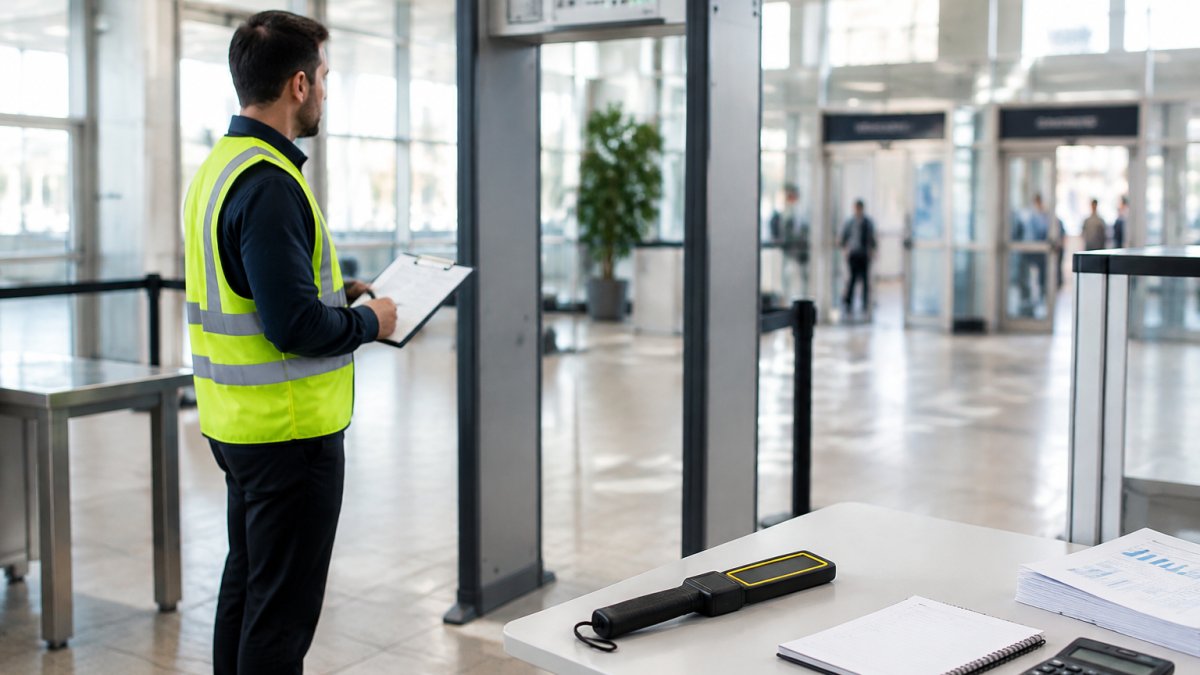
Total cost of ownership for metal detectors is the sum of acquisition, operation, maintenance, compliance, and replacement costs across the equipment's useful life. Most buyers only count the first item.
Building the model line by line
A workable TCO model has five lines. Populate each with your own quotes and internal estimates rather than vendor list prices, because the spread between sites is large.
- Acquisition. Purchase price, or lease payments plus fees, origination costs, and any end-of-term buyout you expect to exercise. Include delivery, installation, and site preparation such as power, mounting, and signage.
- Operation. Staffing to run the checkpoint, initial and refresher training, throughput impact on queues, and the labor to manage alarms and secondary screening. Throughput matters: a detector that slows the line can cost more in staffing than it saves in purchase price.
- Maintenance. Preventive visits, repair labor and parts, calibration, and consumables such as hand-held wands, test pieces, and batteries. Ask for a multi-year service quote, not a first-year number.
The costs competitors leave out: uptime and service response
Two costs get skipped in most vendor comparisons: downtime and compliance. A detector that is offline is a bottleneck at the door, and repair response time directly affects throughput and staffing cost.
Model downtime explicitly. Estimate the hours per year the equipment is unavailable, multiply by the labor cost of the staff idled or reassigned, and add the cost of any loaner equipment or manual screening you fall back on.
Compliance and record-keeping as a recurring cost
Screening equipment carries testing, calibration, and documentation obligations that vary by jurisdiction and by the standard your site follows. Budget staff time for record-keeping, the cost of any third-party testing or certification, and the cost of software or firmware updates that affect compliance. If you lease, confirm which of these the lessor covers and which remain yours; if you buy, assume they are yours unless a service agreement says otherwise.
Comparing lease and buy on the same model
To compare fairly, run both options through the same five lines over the same horizon. For a lease, sum payments, fees, expected buyout, and any service not included. For a purchase, sum price, installation, maintenance, compliance, and replacement, then subtract any expected residual or trade-in value. The option that looks cheaper on monthly payment can lose once downtime, compliance, and end-of-term costs are included, and the reverse is also common.
A common pattern: buying wins on long-horizon, high-volume checkpoints where equipment stays in service through its useful life, while leasing wins where the replacement cycle is shorter than the equipment's physical life or where cash preservation matters more than lifetime spend.
For a fuller view of ongoing obligations, see our guide to security detector maintenance and support.
Matching the Acquisition Model to Your Deployment Scenario
The right model follows the deployment, not the other way around. Here is how we would decide:
- Permanent school checkpoint: buy, for control and long-horizon cost.
- Large event venue with seasonal peaks: lease or rent, depending on calendar density.
- Government facility with strict compliance: buy or lease with a service agreement that covers inspection records.
If you are unsure, start with a rental to test throughput and false-alarm rates, then move to a lease or purchase once the need is proven.
Frequently Asked Questions
Is leasing security screening equipment better than buying it?
Neither is universally better. Leasing keeps upfront cost low, spreads payments into predictable operating expenses, and makes it easier to upgrade when detection technology changes. Buying gives you full asset control, no end-of-term restrictions, and a lower total cost over a long service life. For a permanent K-12 or government checkpoint used daily for a decade, buying usually wins on lifetime cost. For a temporary event venue or a site testing a new screening lane, leasing or renting limits your risk.
What costs should businesses compare when weighing leasing vs buying security screening equipment cost?
Compare four layers, not just the sticker figure. First, upfront cost: down payment versus full purchase price. Second, recurring cost: lease payments versus financing interest and maintenance. Third, lifecycle cost: repairs, calibration, replacement parts, and staff training over the useful life. Fourth, end-of-term cost: buyout price, return shipping, or renewal fees. Add the tax treatment of each, since lease payments and depreciation are handled differently. Pricing depends on quantity, dates, and delivery, so request a quote for both models.
Can businesses rent security screening equipment instead of leasing or buying?
Yes. Rental suits short-term needs such as a concert series, a temporary construction site, or a one-off government event where screening is required for days or weeks rather than years. You avoid a long lease term and return the equipment when the event ends. For recurring seasonal events, compare a series of rentals against a short lease before committing.
How do maintenance and support differ when leasing versus buying screening equipment?
Confirm the service terms for any lease or purchase with us in writing, including response time, spare parts availability, and whether loaner units are provided. Screening cannot go offline for weeks, so a defined repair response matters more than the payment size.
The real risk in this decision is not picking the wrong model. It is picking one without counting the costs that show up after year one. Metal Defender supplies walk-through and hand-held detectors through direct sales, leasing, and rentals, with optional accessories and support to match how you actually deploy. Get started with Metal Defender and choose an acquisition model built around your budget, your sites, and your screening volume.