 ultimate-guide
Security Screening Equipment for Government Buildings
Table of Contents
- Building a Screening Strategy for Government Facility Security Screening
- Walk-Through Metal Detectors for Government Buildings: Selection and Placement
- Handheld Metal Detectors for Visitor Screening and Secondary Checks
- Baggage Scanners for Government Facilities: X-Ray and Explosive Detection
- Comparing Screening Technologies: Metal Detection vs. X-Ray vs. Camera-Based Systems
- Government Standards, Procurement Requirements, and Compliance
- Screening Operations, Staffing, and Throughput Management
- Conclusion
- Frequently Asked Questions
Last Updated: October 16, 2026
Building a Screening Strategy for Government Facility Security Screening
Security screening equipment for government buildings is the layered system of walk-through detectors, handheld wands, baggage scanners, and camera-based tools used to control entry, detect prohibited items, and protect staff and visitors at municipal, state, and federal facilities. Metal Defender supplies walk-through and handheld metal detection systems for this environment, and a common mistake is buying hardware before defining the threat profile.
A courthouse facing domestic-violence cases has a different risk profile than a license-issuing office that sees 2,000 people a day. The Cybersecurity and Infrastructure Security Agency's facility security guidance frames this as risk-based security: match countermeasures to an assessed threat, not to a generic checklist.
This guide covers how to choose, place, staff, and maintain security screening equipment for government buildings, and what the procurement paperwork actually demands.
Walk-Through Metal Detectors for Government Buildings: Selection and Placement
Walk-through metal detectors belong at the primary entry point of any government building where weapons screening is required.
Multi-zone walk-through detectors are the standard choice for government facilities.
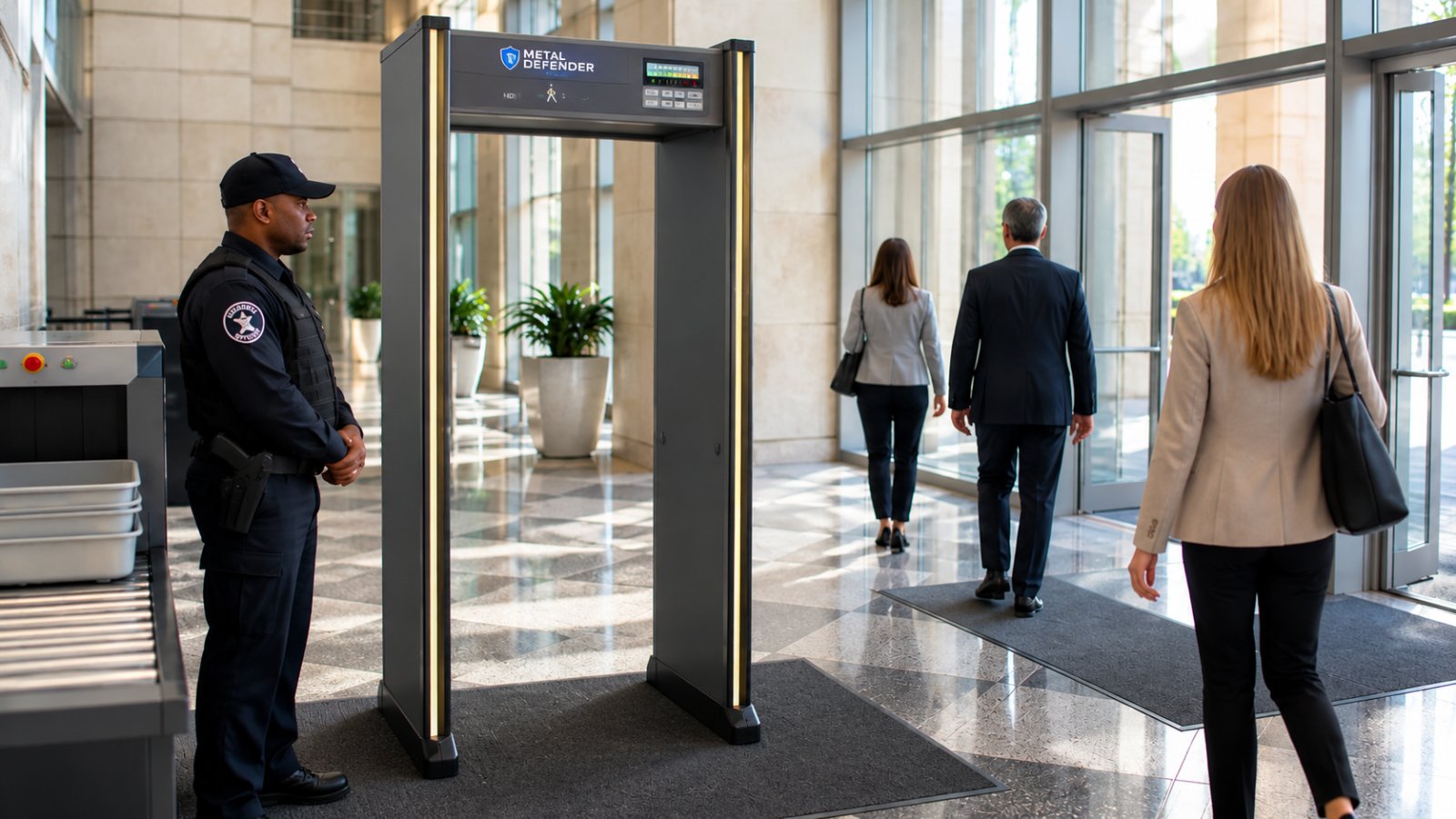
A walk-through metal detector arch at the entrance of a government building lobby, a uniformed security officer standing beside it, visitors approaching the checkpoint through glass doors, morning light through tall windows
Three placement rules to consider:
- Set the arch at least 1.5 metres from the nearest door to prevent crowding inside the detection field
- Leave a clear secondary screening lane beside the arch, not behind it
- Mount the detector on a level, stable surface; uneven flooring causes false alarms
Handheld Metal Detectors for Visitor Screening and Secondary Checks
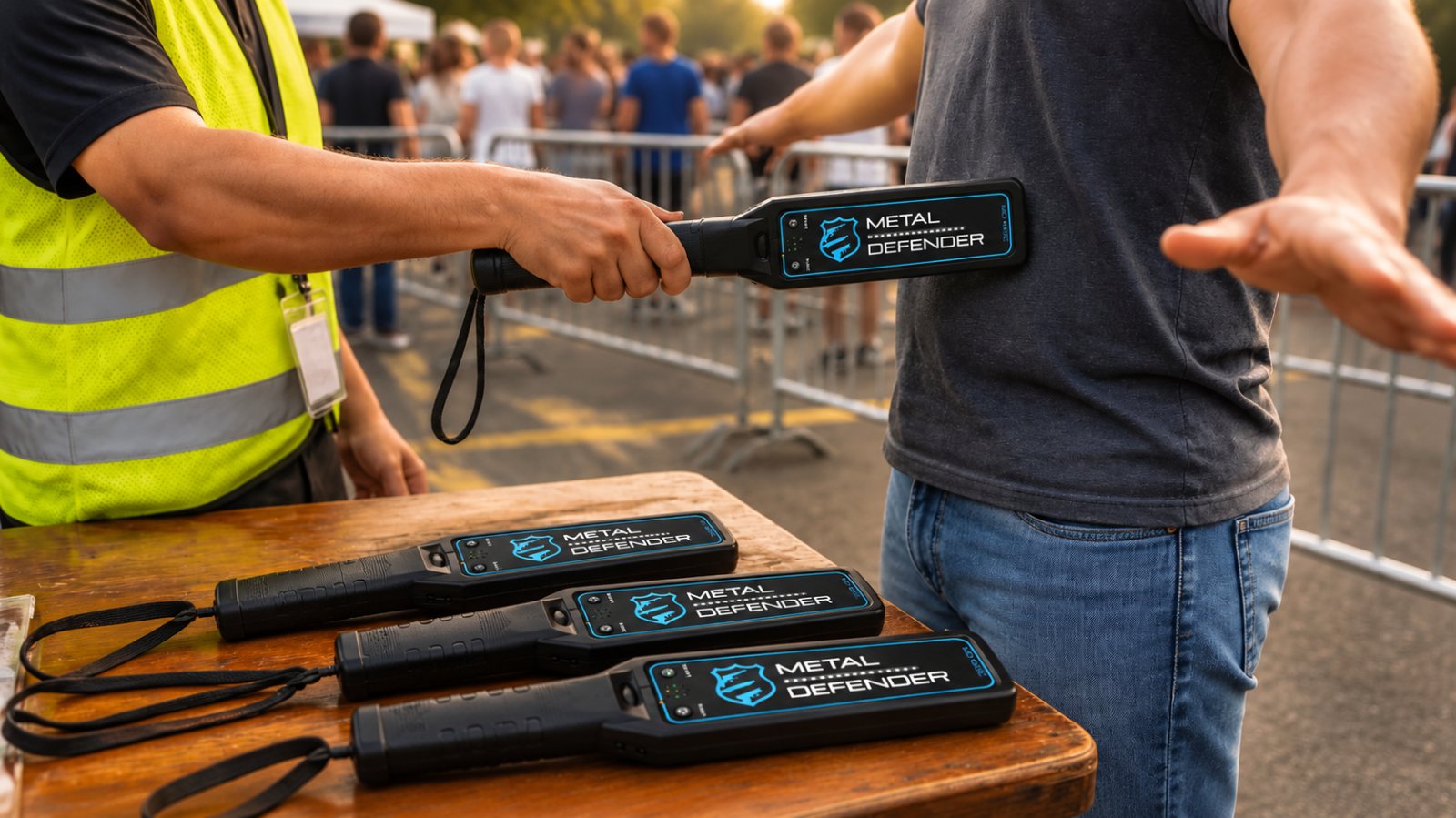
Handheld metal detectors handle secondary screening: the wand check after a walk-through alarm, plus visitor screening at secondary entrances where a full arch isn't practical.
Handheld performance depends on how the officer uses it: a wand swept too fast misses small items.
For visitor screening at side doors, reception desks, and loading docks, handheld units give you coverage without a permanent installation.
Baggage Scanners for Government Facilities: X-Ray and Explosive Detection
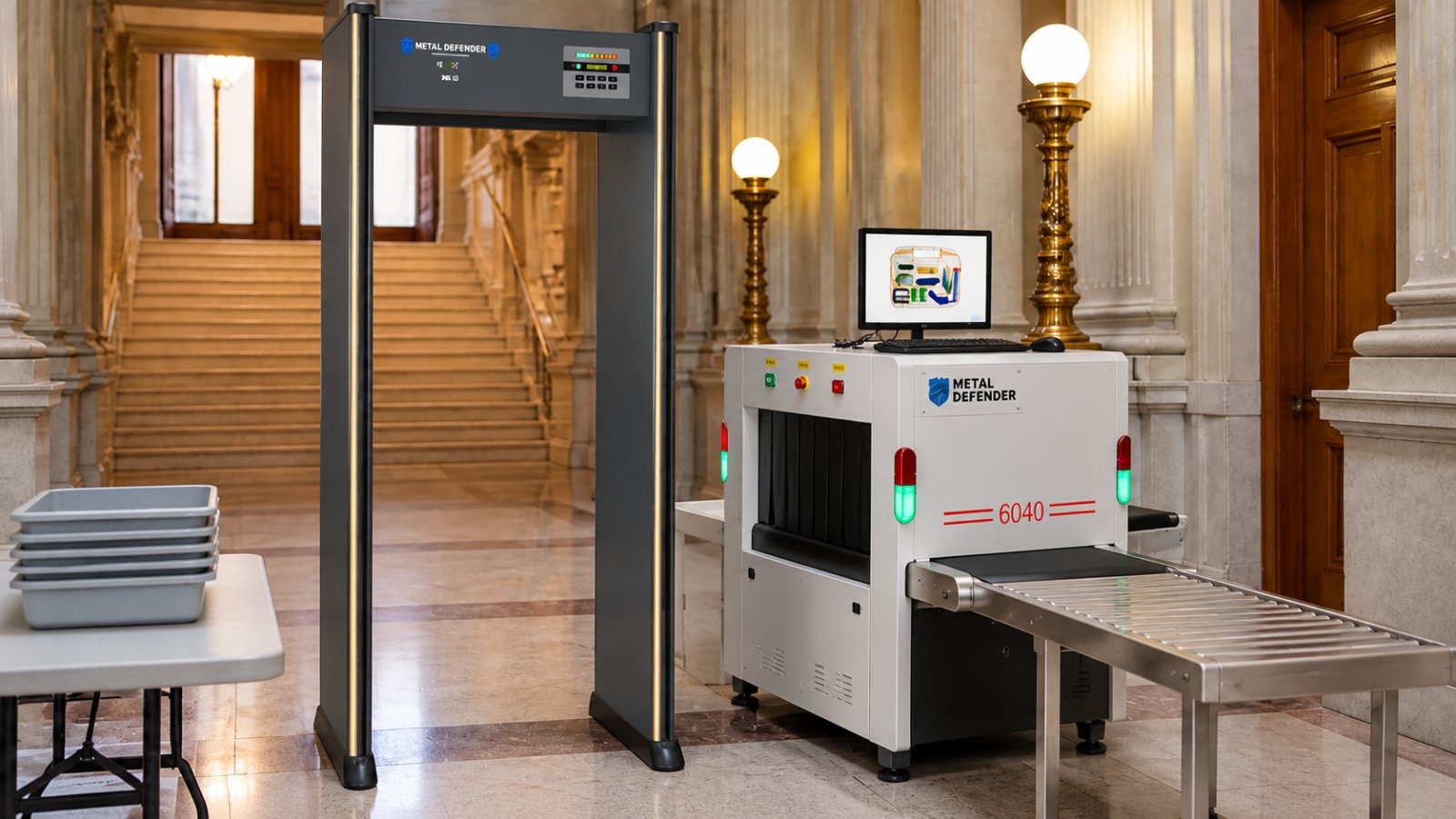
X-ray baggage scanners screen bags, parcels, and deliveries for weapons, prohibited items, and explosive threats.
Two categories matter for procurement. Conventional X-ray systems produce a colour-coded image a trained operator interprets.
The trade-off is real: X-ray screening requires trained operators, a dedicated lane, and ongoing image-interpretation refreshers. A facility that buys a scanner but doesn't fund operator training has bought an expensive conveyor belt.
Scanner Type | Screens For | Staffing Demand | Best For |
|---|---|---|---|
Conventional X-ray | Weapons, prohibited items | Trained image operator | General government entrances |
Explosive detection system | Explosives, weapons | Trained operator plus supervisor | High-risk federal facilities |
Hand-search station | Anything, at low volume | One officer | Low-traffic side entrances |
Comparing Screening Technologies: Metal Detection vs. X-Ray vs. Camera-Based Systems
Most government facilities don't need a single screening technology. They need a layered checkpoint where each tool covers the next one's blind spot.
Walk-through metal detectors (WTMD)
- Detects: ferrous and non-ferrous metal weapons, firearms, knives, blunt metal objects
- Blind to: ceramic knives, 3D-printed polymer weapons, explosives, and most organic threats
- Throughput: typically 300-600 people per hour per lane under normal conditions, higher with multi-zone arches and trained officers
- Staffing: one officer per lane minimum, plus a wand officer for alarms
Handheld metal detectors (wands)
- Detects: the same metal targets as a WTMD, at close range
- Blind to: the same non-metallic threats
- Throughput: depends entirely on officer technique; a slow, consistent sweep resolves most alarms in under 30 seconds
- Staffing: one officer per wand
X-ray baggage scanners
- Detects: weapons, prohibited items, and, with an explosive detection system (EDS), explosive material inside bags, parcels, and mail
- Blind to: threats carried on the person, not in a bag
- Throughput: roughly 200-400 bags per hour for a conventional X-ray with a trained operator; slower when secondary bag searches are required
- Staffing: one trained image operator per scanner, plus a bag-search officer
Camera-based weapons detection
- Detects: firearms and some weapons using computer vision on existing or dedicated cameras, often flagging objects or behaviour across a lobby, corridor, or perimeter
- Blind to: items inside bags, and it cannot physically stop anyone
- Throughput: does not gate entry, so it does not create a queue, but every alert still requires a human to assess and respond
- Staffing: monitoring personnel, plus a response team for alerts
How to choose
The decision comes down to three variables: what you're screening (people, bags, or both), peak arrival volume, and sustainable staffing. A common pattern is:
- People only, high volume: WTMD at the primary entrance, wands for alarm resolution
- People and bags: WTMD plus X-ray on the same lane, with a bag-search table beside it
- People, bags, and wide-area coverage: WTMD plus X-ray at the checkpoint, camera-based detection covering the queue, lobby, and perimeter
- Low-volume or irregular access points: wands and a hand-search station, with camera coverage as a backstop
A useful rule of thumb: metal detection is your fastest per-person screen, X-ray your only content-level screen, and camera-based detection your only continuous screen.
National Institute of Standards and Technology's security technology testing programs publishes evaluation criteria for detection equipment, which is worth reviewing before you write a specification.
Government Standards, Procurement Requirements, and Compliance
Government procurement adds a layer private buyers never face: specifications must be competitively bid, equipment must meet applicable detection standards, and the contract has to survive an audit years after award.
Standards and testing bodies to reference
Contact Us For Your Ordering & Rental Needs →
You don't need to become a standards expert, but your solicitation should point bidders to the right references. The most commonly cited in U.S. government screening procurements are:
- National Institute of Justice (NIJ), publishes performance standards for walk-through and handheld metal detectors (NIJ Standard-0601.02 for hand-held detectors and NIJ Standard-0602.02 for walk-through detectors). These define detection sensitivity, alarm signalling, and environmental requirements.
- National Institute of Standards and Technology (NIST), runs testing and evaluation programs for security equipment and publishes criteria that procurement teams can adopt by reference.
- Transportation Security Administration (TSA), maintains qualified technology lists for baggage and checkpoint screening equipment; even non-aviation government buyers often use the TSA list as a de facto benchmark.
- Cybersecurity and Infrastructure Security Agency (CISA), publishes facility security guidance and risk-assessment frameworks that help justify the screening program itself.
- American National Standards Institute (ANSI), publishes accessibility and safety standards that may apply to checkpoint layout and equipment placement.
Referencing a standard by name and number in the solicitation is what separates a defensible specification from a vague one.
Writing a specification that survives a bid protest
A specification written around one vendor's features can invite a protest and narrow competition. A stronger approach involves:
- State the performance requirement, not the product. "Detect a specified test object at a specified height" is defensible; "must have 18 zones" is not.
- Require test documentation. Ask bidders to submit third-party test reports against the cited standard, not just a manufacturer's spec sheet.
- Define the acceptance test. State how you will verify detection performance after installation, typically with a standard test-object kit and a documented pass/fail threshold.
- Separate equipment from services. Warranty, maintenance response time, spare-parts availability, and operator training should be priced and evaluated separately so you can compare total cost, not just unit price.
Accessibility considerations
Screening checkpoints must accommodate visitors who use wheelchairs, walkers, service animals, or mobility devices, and those who cannot pass through a metal detector for medical reasons. Plan for:
- A clear, level path through or around the checkpoint that meets applicable accessibility standards
- A documented alternative screening procedure (typically a handheld wand and, if needed, a physical inspection conducted by a trained officer of the same gender)
- Signage that tells visitors what to expect and how to request an accommodation
- A private secondary screening area, not a public one
Procurement pathways
Government buyers typically acquire screening equipment through one of four routes: open competitive solicitation, a state or cooperative purchasing contract, a GSA Schedule or equivalent federal vehicle, or a sole-source justification when only one product meets a documented requirement.
Verifying compliance after award
Compliance does not end at contract signature. Build in:
- A post-installation acceptance test against the cited standard
- A calibration and maintenance log the vendor must maintain and you must review
- Operator training records, since many standards assume a trained operator
- A periodic re-test schedule (annually is a common baseline) to confirm detection performance has not drifted
A specification that says "industry-standard metal detection" can lead to bids that technically comply but may not meet functional expectations. Naming the standard, the test, and the acceptance criteria can help avoid post-installation disputes.
The specification you write determines the equipment you get. Consider the standard reference, the acceptance test, and the maintenance terms as critical clauses in government screening contracts.
Screening Operations, Staffing, and Throughput Management
Equipment alone doesn't screen anyone. Throughput is a staffing equation: how many people per hour can move through your checkpoint, and how many officers does that require?
Measure your peak arrival rate first, then size the checkpoint to that number rather than the daily average.
Queue management is the other half: clear signage, a single-file approach lane, and a designated secondary screening spot keep the line moving and reduce visitor frustration.
Facilities with sharp arrival peaks and limited lobby space, where portable or relocatable detection units let you add a second lane on high-traffic days without a permanent installation.
Conclusion
Every government facility eventually faces the same moment: the threat assessment says you need screening, and the budget says you need it now. Getting the technology mix right, matching equipment to entry points, and planning staffing and maintenance from day one can contribute to an effective security checkpoint. Metal Defender supplies walk-through and handheld metal detection systems with flexible acquisition options, including leasing and rentals, so facilities can equip a checkpoint without a full capital purchase.
Frequently Asked Questions
What equipment is used to screen visitors at government building entrances?
Most government facilities use a combination of walk-through metal detectors, handheld wands, and X-ray baggage scanners. Walk-through detectors screen people entering the building, while handheld units are used for secondary screening when alarms trigger. Baggage scanners examine bags and packages for prohibited items, including weapons and explosives. Some facilities also use camera-based detection systems and access control measures to supplement physical screening equipment.
How do walk-through and handheld metal detectors work together?
Walk-through detectors create a primary screening layer at entry points, alerting staff when someone carries metal objects. When an alarm sounds, security personnel use handheld detectors to pinpoint the exact location of the metal item, whether it is a belt buckle, phone, or something more concerning. This two-step process reduces false alarm disruptions and keeps screening throughput steady. The handheld unit provides flexibility for visitor screening at secondary checkpoints or mobile locations.
How should a government facility choose security screening equipment?
Start by assessing your building's threat profile, daily visitor volume, and entry point layout. Government buildings with high foot traffic need equipment that maintains screening throughput without creating long queues. Consider detection capability, false alarm rates, and whether the equipment can be integrated with existing access control and video surveillance systems. Procurement rules and compliance standards also shape what you can buy, so involve your procurement team early in the process.
What factors affect the cost of security screening equipment for a government building?
Pricing depends on the type of equipment, detection sensitivity, throughput requirements, and whether you buy, lease, or rent. Walk-through detectors cost more than handheld units, and X-ray baggage scanners represent a larger investment. Installation, training, maintenance contracts, and optional accessories also affect the total cost of ownership. Government procurement may require specific compliance certifications, which can influence equipment selection. Contact suppliers directly for quotes based on your facility's needs.
How can you make a government building more secure beyond screening equipment?
Screening equipment works best alongside layered security measures. Access control systems restrict entry to authorized personnel, while video surveillance provides monitoring and evidence. Intrusion detection and perimeter sensors alert staff to unauthorized access attempts. Visitor management systems track who enters and exits the building. Emergency response tools like panic buttons and intercom systems support rapid reaction to incidents. A risk-based security approach combines these layers to address the specific threats your facility faces.